

How To Clean Inside Canon Camera Lens Without Unscrew
Ane of the most frequently asked questions that I get from our readers, is what to do with grit inside a lens and whether it is something to worry about. I decided to write an commodity on this subject, because lens dust and flecks are a very common effect not only for camera sensors, only also for lenses. When I offset discovered dust within my brand new lens that I only used for a couple of days, I was very disappointed and I remember how I started searching for a solution online in panic way. If you are frustrated with a similar issue and do non know what to practise, keep on reading.
1) How to Inspect Lens for Dust
So, how can you find out if you have dust inside your lens? Actually, let me rephrase this question – how can you find out how much dust you have inside your lens? Because even brand new lenses normally do have some foreign particles in between lens elements. A quick visual inspection of the lens front volition often reveal large dust particles behind the offset lens element, if at that place are any. Only make certain that the front end is thoroughly cleaned beforehand and whatever protective filters are removed. Look straight and then inspect the lens at an angle and you might run across some grit behind the front glass element. Now if you really desire to see grit, and I promise you volition, here is the best style to exercise it. First, notice a very bright LED flashlight. You can find those pretty much anywhere nowadays, fifty-fifty in a grocery shop. Next, you lot will need to open the lens discontinuity (the lens obviously needs to be dismounted from the camera, rear lens cap should be removed). If you have an older lens with an aperture band, you only need to ready the aperture ring to the smallest value (which is the largest aperture) like f/1.four or f/two.eight and you are fix to go. If you lot accept a modern lens like Nikon "Yard" type AF-S lenses, so you lot volition need to push upwardly a small metallic lever to open up the lens aperture as seen below. To keep the lens aperture open, you will need to keep pushing information technology with ane finger:
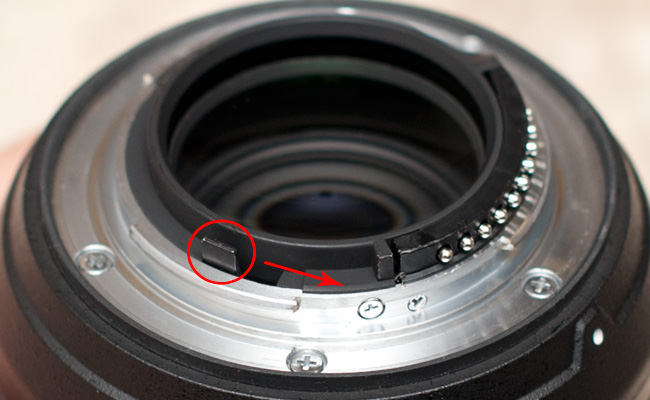
Once the lens aperture is fully open up, plough on the flashlight and point it towards the rear of the lens with the front lens cap off. Do this in a dim indoor surroundings with lights turned off. Await at the forepart chemical element of the lens at an angle and come across how much grit you have inside the lens. If you accept never seen any dust, you lot volition certainly see information technology now. Better yet, now you lot can see dust in between pretty much every lens chemical element, because it will be visible when a bright source of light goes through the lens. Now here is a word of warning – as I have pointed earlier, don't be surprised to see grit even if you have just bought your lens. Some of those particles might exist dust, others might be pocket-size bubbles and other glass imperfections. Why? You guessed it right, no lens is perfect! Just don't panic, every lens I ain has dust in information technology, even the brand new Nikon 35mm f/1.4G prime that I have recently received from B&H. Take a look at how much dust my Nikon 24-70mm f/two.8G accumulated over the years of abuse:

And here is how the Nikon 50mm f/1.4G looks:
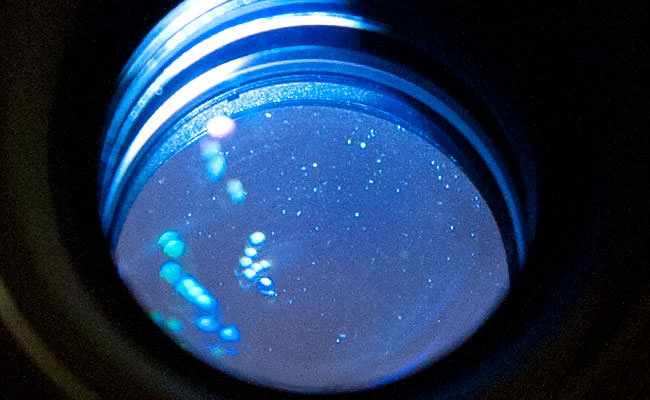
Looks scary, doesn't information technology? But I don't really care, because both lenses produce excellent results and I am sure will continue to practice so for many more years.
2) How and Why Lenses Get Dust
You might be wondering how and why lenses get dust inside. Allow me explain a couple of things about lenses. Every time a lens focuses or it is zoomed in and out, it "breathes". And no, I am not talking about the effect of lens "animate", when an epitome appears smaller or bigger when focus is adapted – I am talking about the process of inhaling and exhaling. Lenses take to breathe, due to lens elements constantly moving inside them when focus is adapted and/or when zooming takes place. Remember what happens with pressure level inside a closed plastic container? If you endeavour to reduce the container size, the pressure inside the container will only let you reduce it to a certain level earlier information technology pushes back. A simple concept of air pressure in physics. Now take the same concept and apply it to lenses. What would happen if lenses were completely sealed from all sides? You would just be able to zoom in a little earlier the lens would strength you lot back to its original state due to pressure level, peculiarly on lenses that extend in size. A similar thing would happen with lens focus. Hence, there was no other fashion for camera manufacturers to design lenses – lenses with moving lens elements must inhale and exhale air. Some lenses are amend than others in managing the air flow. While some expensive lenses are sealed confronting dust (which does non fully stop grit from entering the lens) and volition simply suck the air in and out of the camera bedroom, cheaper consumer zoom lenses are the worst in this regard – they might suck the outside air and blow information technology out right into the camera chamber. Let's have a look at which lenses are worse than others in handling dust.
3) Lenses Prone to Dust
As I take explained above, some lenses are more prone to grit than others. Here is the list of lens types that are more prone to dust than others, in the order of "worst to best":
- Consumer zoom lenses with extending barrels – examples: Nikon xviii-55mm f/3.5-5.6G VR DX, Catechism 18-55mm f/3.five-5.6 IS. Nigh inexpensive plastic consumer lenses accept no weather sealing of whatsoever kind, including safety gaskets that wrap effectually the camera mount. In very dusty environments, they will suck the exterior air into the lens and then into the camera sleeping room.
- Professional zoom lenses with extending barrels – examples: Nikon 24-120mm f/iv VR, Catechism 24-105mm f/4L IS. Cheaper pro-level lenses with Crimson (Catechism) and Aureate (Nikon) rings often have similar weather condition protection equally expensive pro-level zooms, just are generally more prone to dust due to significant changes in lens barrel length. Most come up with prophylactic gaskets on the lens mount to prevent dust from entering the camera chamber through the lens mount.
- Expensive/peak-of-the-line professional zoom lenses with extending barrels – examples: Nikon 24-70mm f/ii.8G, Canon 24-70mm f/two.8L. Elevation-of-the-line professional zoom lenses typically have meliorate weather sealing all around the lens. Safety gaskets are ever included and other rubber seals are nowadays in other parts of the lens such as zoom ring, focus ring, switches, etc.
- Professional person zoom lenses with stock-still barrels – examples: Nikon 70-200mm f/2.8G VR II, Canon 70-200mm f/2.8L IS. Lenses that do not change in barrel size are mostly better against dust and moisture. Since nada moves, at that place are fewer places where grit can accumulate and so brand into the lens. Rubber gaskets and other condom seals are also present in all areas where dust can potentially enter the lens.
- Prime lenses with extending front end chemical element – examples: Nikon 50mm f/1.4D, Canon 50mm f/1.4 USM. Prime number lenses are generally less prone to dust than zoom lenses, because fewer parts move inside them. Prime number lenses with moving front element that changes in length as you focus are generally better than zoom lenses, just grit can withal make information technology into the lens through the forepart. Rubber gasket on the mount is sometimes absent (especially on older models), which can likewise contribute to dust making it into the camera sleeping room and the lens.
- Prime lenses with fixed barrels – examples: Nikon 35mm f/1.8G, Nikon 24mm f/1.4G, Canon 24mm f/1.4L Two. Prime number lenses with non-extending barrels are typically protected best against dust. Some of the prime lenses with rear focus feature (such as Nikon 24mm f/1.4G and Nikon 35mm f/one.4G) might have a moving rear lens chemical element as you focus, while others have a fixed glass element that never moves. The latter is typically better than the former. Many of the mod prime models are designed with rubber gaskets effectually the lens mountain and loftier-terminate models have additional weather sealing in other parts of the lens.
As yous can see, prime lenses are generally better protected against dust than zoom lenses. However, there are exceptions, where some primes are worse than some of the zooms in terms of handling dust and moisture.
4) What to do with lens dust
One time you spot lens dust, what should yous practice with it? The answer is – nothing. Don't worry about it and just continue on shooting, concentrating on creating not bad images. As I have explained above, lens grit is a normal fact of life, just like dust on your camera sensor. Even if you take a good care of your gear on a daily basis, you lot volition eventually end up with grit in your lenses and cameras, guaranteed. You lot can certainly minimize the amount of grit getting into your gear by storing it properly and performing regular cleaning and maintenance (which I will cover in an upcoming video tutorial), but you cannot fully forestall it from happening. Dust is inevitable and it does get into camera gear one mode or another, so yous should non be sweating over it if you have information technology. Try an experiment – come up close to a muddied window in your business firm and wait outside. When your eyes focus on the outside, can you come across the dust or dirt on your window with your optics? No, unless the clay particles are huge. The same thing happens inside the lens, if in that location are small dust particles, it is not a big bargain. So take a deep breath, chillax and stop worrying most dust.
The simply case where you might need to phone call your lens manufacturer, is if you lot spot an abnormally big spec of dust more than several millimeters in size that moves when you rotate the lens. There are cases, when particles break off inside lenses, typically after lenses are dropped/damaged.
If yous are a very brave soul, you can endeavor removing dust from your lenses past doing something similar this. However, there is a high risk of potential harm, so practise it at your own hazard!
5) How to remove lens dust
Never, under any circumstances attempt to remove dust from inside lenses yourself. Disassembling your lens will non simply void the warranty, but I can well-nigh guarantee that you will not exist able to assemble information technology dorsum the style it was yourself. If large amounts of dust are heavily affecting your images and yous have a very low level of contrast, call the lens manufacturer and find out if they can clean the lens interior and how much information technology will price. Your normal lens warranty will Not include disassembling the lens and cleaning its interior, so you volition accept to pay a hefty sum for that kind of service. In many cases, you are better off buying a new lens than trying to get an old i fixed. So, once again, never try to practice this yourself and certainly never let a non-professional endeavor to do it for you.
6) Minimizing dust and mucus
Shooting in relatively clean environments, properly storing your gear in a cool, dry identify and taking care of it by performing regular cleanup and maintenance is a good mode to eliminate fungus and minimize the amount of dust that ends upward on and in your gear.

Source: https://photographylife.com/what-to-do-with-dust-inside-lens
Posted by: mcavoybearld.blogspot.com
0 Response to "How To Clean Inside Canon Camera Lens Without Unscrew"
Post a Comment